Living together
Roommate agreement template: what to include, with a filled-in sample
A roommate agreement is a short written record of how you'll share the apartment: who pays what rent and which utilities, how the deposit is split, chores, guests, quiet hours and what happens when someone moves out. Copy the template below, fill it in together in one sitting, and everyone signs.
By Jack JonesUpdated 18 min read
The short version
- A roommate agreement is between you and your roommates. Your lease is between you and the landlord, and the agreement doesn't change it.
- Cover the things people actually fight about: rent, utilities, the deposit, chores, guests, quiet hours and moving out.
- Write numbers, not intentions: dollar amounts, due dates, how many nights a guest can stay, how much notice to give.
- Fill it in together in one house meeting, everyone signs and keeps a copy, and you review it after the first month.
- Renting a room to someone who isn't on the lease? That's a roommate rental agreement: add the room, the rent, the term and the notice period, and check the lease allows it first.
What a roommate agreement is (and what it isn't)
A roommate agreement is a document you and your roommates write and sign, setting out how you'll share the apartment and its costs. The lease tells the landlord who pays the rent. The roommate agreement tells each other how: who pays which share, when, and what happens if plans change.
It's not a replacement for the lease, and it can't override it. If the lease says no pets, a roommate agreement that allows a cat doesn't help you with the landlord. Read the lease first, then write an agreement that fits inside it.
| The lease | The roommate agreement | |
|---|---|---|
| Between | The tenants and the landlord | The roommates |
| Covers | Total rent, the deposit, the length of the tenancy, the landlord's rules | Each person's share, utilities, chores, guests, quiet hours, moving out |
| Who writes it | Usually the landlord | You, together |
| Changes when | The landlord and tenants agree in writing | Everyone in the apartment agrees |
Do you need a roommate agreement if you're already friends?
Especially then. Friends are the people most likely to skip the conversation because it feels formal, and least likely to want the argument six months later. The agreement isn't about trust. It's about memory: in March, nobody remembers exactly what was said in August about the internet bill or how long a partner could stay.
Writing it down also forces the decisions you'd otherwise make by accident. “We'll sort the deposit out later” becomes a number on a page, and later is a lot calmer for it.
What to include in a roommate agreement
Ten sections cover almost every apartment. For each one, the job is to answer one question with a specific answer:
| Section | The question to answer | Write it as |
|---|---|---|
| Rent | Who pays what share, to whom, by when? | Dollar amounts and a due date |
| Utilities and shared bills | Which bills are shared, and how is each one split? | A list of bills, with a method each |
| Security deposit | Who paid what, and how is it split at the end? | Dollar amounts, and a rule for deductions |
| Chores | Who cleans what, how often, and what counts as done? | Zones, a rotation and a deadline |
| Groceries and supplies | What's shared, and who buys it? | A shared-items list and a rule |
| Guests and partners | How long can a guest stay, and when does a guest start paying? | A number of nights |
| Quiet hours and shared space | When is it quiet, and how is the shared space used? | Times and rules |
| Pets, smoking and parking | What does the lease allow, and how do you share it? | Yes/no, and who's responsible |
| Moving out | How much notice, and who finds a replacement? | Days of notice and steps |
| Disagreements and changes | How do you raise a problem, and how do you change the agreement? | A process |
The money sections matter most, because they're the ones that turn into debts. If you haven't decided how to split rent and utilities yet, start with our guide on how to split bills with roommates: equally, by room size, by income or by usage.
Free roommate agreement template
Print it, or copy it into a shared doc, and fill in every blank together. Cross out anything that doesn't apply rather than leaving it empty, so nobody wonders later whether you forgot.
Roommate agreement template
Fill in each blank in one house meeting. Everyone signs at the bottom and keeps a copy.
1. Who and where
- Address: ________________ · Lease from ________ to ________
- Roommates: ________________ (names on the lease: ________________)
- This agreement starts on ________ and lasts as long as the lease, unless we all agree to change it
2. Rent
- Total rent: $________ a month, due to the landlord on the ____ of the month
- Each person's share: ________ $______ · ________ $______ · ________ $______
- How we worked out the shares: equal / by room size / other: ________________
- Rent is paid by ________ (one person pays the landlord) / each of us pays the landlord directly
- Everyone pays their share to that person by the ____ of the month
3. Utilities and shared bills
- Electric: in ________'s name, split ________
- Gas / water / trash: in ________'s name, split ________
- Internet: in ________'s name, split ________
- Streaming and subscriptions: only the people who use them pay
- We settle up for all shared bills on the ____ of every month
4. Security deposit
- Total deposit: $________ · paid by: ________ $______ · ________ $______ · ________ $______
- Damage in a bedroom comes out of that person's share; damage in shared space is split ________
- When someone moves out, their share of the deposit is returned by ________ (the incoming roommate / when the landlord returns it)
5. Chores
- We split shared chores into zones and rotate them every ________
- Each zone is done by ________ (day and time)
- Dishes: ________________
- If someone misses their zone: ________________
6. Groceries and shared supplies
- Shared items: toilet paper, dish soap, paper towels, trash bags, ________________
- Shared items are bought by ________ and split ________
- Food is separate / shared staples only / fully shared
7. Guests and partners
- Give the apartment a heads-up before an overnight guest
- A guest can stay up to ____ nights in a row and ____ nights a month
- A guest who stays more than ____ nights a week pays $______ a month toward utilities
- Nobody moves in, even part-time, without everyone agreeing (and the landlord, if the lease requires it)
8. Quiet hours and shared space
- Quiet hours: ____ to ____ on weeknights, ____ to ____ on weekends
- Parties or get-togethers of more than ____ people: agreed at least ____ days ahead
- Shared space is cleared of personal stuff by ________
- Borrowing someone's things: ask first / these items are fine to share: ________________
9. Pets, smoking and parking
- Pets: not allowed / allowed under the lease: ________, owned by ________, who covers any damage they cause
- Smoking and vaping: not inside / ________________
- Parking space or storage: used by ________ (who pays $______ extra a month)
10. Moving out, disagreements and changes
- Anyone leaving gives ____ days' notice in writing to the others
- The person leaving keeps paying their share until ________ (the lease ends / a replacement moves in / the notice period ends)
- A replacement roommate needs everyone's agreement (and the landlord's, if the lease requires it)
- Bills are prorated to the move-out day and settled before the person leaves
- Problems are raised in person, or in a house meeting, before they're raised in the group chat
- This agreement changes only when everyone agrees, in writing
Signatures
- Name ________________ · Signature ________________ · Date ________
- Name ________________ · Signature ________________ · Date ________
- Name ________________ · Signature ________________ · Date ________
A filled-in roommate agreement sample: three roommates
Blanks are easier to fill in when you've seen an answer. Here's how Alex, Sam and Jordan filled in the money sections for a three-bedroom apartment at $2,400 a month, where the bedrooms are different sizes.
Rent, split by room size
They agreed that half the rent ($1,200) pays for the shared space, split equally at $400 each, and the other half is split by bedroom square footage: Alex's room is 150 sq ft, Jordan's 130 and Sam's 120, out of 400 in total.
| Roommate | Bedroom | Shared half | Bedroom half | Rent each month |
|---|---|---|---|---|
| Alex | 150 sq ft | $400 | $450 (150/400 of $1,200) | $850 |
| Jordan | 130 sq ft | $400 | $390 (130/400 of $1,200) | $790 |
| Sam | 120 sq ft | $400 | $360 (120/400 of $1,200) | $760 |
| Total | 400 sq ft | $1,200 | $1,200 | $2,400 |
Utilities, the deposit and shared supplies
- Electric: in Alex's name, split equally. Jordan works from home every day, so adds a flat $15 a month on top.
- Internet: in Jordan's name, $60 a month, split equally at $20 each.
- Streaming: Sam and Jordan share one service; Alex isn't in, so doesn't pay.
- Deposit: one month's rent ($2,400), paid in the same proportions as the rent: Alex $850, Jordan $790, Sam $760. Each gets the same share back, minus any damage to their own room.
- Shared supplies: toilet paper, dish soap, trash bags and paper towels, split equally. Whoever has the trash-and-supplies zone that week does the run.
- Settle-up day: the 28th, the same day rent shares are due, so there's one money conversation a month, not five.
Every number in the sample is a decision the three of them made once, so it never has to be argued about again. Yours will be different; what matters is that they're written down.
The guest and partner clause
This is the clause people skip and then need most. A partner who stays “a couple of nights” slowly becomes a fourth roommate who uses the shower, the electric and the couch, and doesn't pay. Nobody wants to be the one to say so, which is exactly why it belongs in the agreement before anyone's dating anyone.
- A heads-up, not a permission slip. A message to the apartment before an overnight guest is enough for most homes.
- A number, not a feeling. “Up to three nights in a row and eight nights a month” is easy to keep track of. “Not too often” isn't.
- A point where a guest starts contributing. For example: more than three nights a week for a month, and they chip in toward utilities and shared supplies.
- Moving in is a different conversation. A new person living there needs everyone's agreement, and possibly the landlord's, so check the lease.
In House Plan, a regular guest can be added to the house with access to only the parts you choose (the grocery list and the calendar, say, but not the money) and an end date. Free allows 1 guest at a time for up to 7 days; Pro allows up to 4 guests for up to 6 months.
Chores, quiet hours and shared space
Keep the chore section short and point to a chart: “Shared chores are split into four zones and rotate weekly; each zone is done by Sunday night.” The detail lives on the chart, which changes more often than the agreement. Our roommate chore chart has ready-made rotations for 2, 3 and 4 roommates, and a definition of done for each zone you can attach to the agreement.
For quiet hours, pick times that fit the earliest alarm in the apartment, not an average. If one of you starts work at 6, “quiet after 10 on weeknights” is a kindness that costs everyone else very little. Weekends can be later.
Shared space needs one simple rule: personal stuff left in the living room or kitchen is cleared by an agreed time (bedtime, or the end of the day). It heads off the slow creep where one person's bike, laundry and desk gradually take over the common space.
Moving out and replacing a roommate
Most roommate agreements are signed in a good mood and needed in a bad one: when someone leaves early. Agree these four things now, while nobody is leaving:
- 1Notice. How many days' warning the others get. Thirty days is a sensible default: enough time to find someone without leaving anyone stuck.
- 2Who keeps paying. Usually the person leaving pays their share until a replacement moves in or their notice runs out, whichever comes first. Check what the lease says if they're named on it, and write the details up in a roommate release agreement when the day comes.
- 3Who chooses the replacement. Everyone staying gets a say, and the landlord may need to approve them too.
- 4Settling up. Prorate the bills to the move-out day (our bills guide shows how to split bills when someone moves out mid-month) and agree how their share of the deposit comes back: from the new roommate, or when the landlord returns it.
Roommate rental agreement: when one of you rents a room to the other
A roommate rental agreement (also called a roommate lease agreement) is for a different setup: one person holds the lease or owns the home, and rents a room to someone who isn't on the lease. Then the agreement isn't only house rules. It's the new roommate's main written record of what they're renting, for how much and for how long.
Check the lease before you write one. Many leases restrict subletting or adding occupants, or need the landlord's written consent, and renting out a room in a place you rent can count as subletting. Rules on deposits, notice and ending the arrangement vary by state and city, so for anything you'd want to enforce, ask a local tenant-rights organization or a lawyer.
| Clause | What to write down |
|---|---|
| The parties | Who's renting out the room (the tenant on the lease, or the owner) and who's moving in |
| The room | Which bedroom, which shared spaces and storage come with it, and any furniture |
| Rent | The monthly amount, the due date, who it's paid to and how |
| What the rent includes | Which utilities and supplies are included, and which are split separately |
| Deposit | The amount, who holds it, and when and how it comes back |
| Term | A fixed end date, or month-to-month |
| Notice | How many days' written notice either of you gives to end it |
| Landlord consent | Whether the lease needs the landlord's approval, and whether you have it in writing |
Month-to-month roommate rental agreements
A month-to-month agreement runs until one of you gives notice, instead of ending on a fixed date. It suits a room rented while someone looks for a longer-term place, or a home where the person on the lease isn't sure how long they'll share. The trade-off is less certainty for both of you, so the notice clause does the heavy lifting: write the number of days, how notice is given (on paper, or whether a text counts) and the date it runs from. Some states and cities set a minimum notice period, so check yours before you pick a number.
If the rent includes utilities, say so plainly and don't also split the bills. If it doesn't, list which bills are split and how, as in section 3 of the template. Chores, guests, quiet hours and moving out work the same whether everyone is on the lease or one person is renting a room, so copy those sections across.
Roommate release agreement: when someone leaves before the lease ends
A roommate release agreement (sometimes called a roommate release form) is a short written deal for the day someone leaves early: the roommate moving out and the roommates staying agree who takes over the departing person's share, from what date, and how the money between you gets settled. It's the moving-out clause of your agreement, written up for one specific person and date.
The limit is the same as for any roommate agreement: it's between you, not with the landlord. If the person leaving is named on the lease, a release signed only by roommates doesn't take their name off it or change what the landlord can ask them for. To actually come off the lease, they need the landlord's agreement in writing, for example a signature on the release or a lease amendment. Rules vary by state and city, so if a lot of money is at stake, ask a local tenant-rights organization or a lawyer before anyone signs.
| Clause | What to write down |
|---|---|
| Who and when | Who is leaving, who is staying, the move-out date and the date their share of the rent stops |
| Who takes over the rent | Whether a named replacement takes the room, or the remaining roommates cover the share, and at what amount |
| Their deposit share | Whether the replacement pays it to them now, or it comes back when the landlord returns the deposit, and what happens if there are deductions |
| Bills in their name | Which utilities or accounts are in the leaving person's name, who takes them over and by when |
| Final settle-up | Their share of bills up to the move-out day, and the date everyone pays what they owe |
| Keys and belongings | When keys come back and what happens to anything left behind |
| Landlord sign-off | Whether the landlord has agreed to release them from the lease, with a space for the landlord to sign if so |
Example: Jordan moves out and Casey takes the room
Back to the sample apartment. Jordan gives 30 days' notice and moves out on November 30. Casey takes Jordan's room from December 1 at the same $790 a month, and the landlord signs the release and adds Casey to the lease. Their release agreement says:
- Rent: Jordan pays November's $790 as usual. From December, Casey pays $790 to Sam by the 28th of the month before, like the others.
- Deposit: Casey pays Jordan $790 directly, Jordan's share of the deposit. The deposit itself stays with the landlord, and at the end of the lease Casey gets that share back, minus any damage to the room.
- Internet: it's in Jordan's name, so it moves to Casey's name by November 30 and stays $20 each.
- Electric: November's bill comes in at $96, $32 each, plus Jordan's flat $15 for working from home, so Jordan's share is $47. Alex has the electric in their name, so Jordan pays Alex $47 when the bill arrives.
- Keys: Jordan hands their keys to Casey on November 30.
Without the landlord's signature, the same page still works between the four of you, but Jordan stays on the lease. Then the agreement should also say that if the landlord ever asks Jordan for rent or damage from after November 30, the roommates staying will pay it back.
How to write it together without it feeling like a contract
The way you write it matters as much as what's in it. A roommate who's handed a finished agreement to sign feels managed; one who helped fill in the blanks feels it's theirs.
- Do it in the first week, before anyone is out of pocket or annoyed. Before you move in is even better.
- Frame it as memory, not mistrust: “Can we write down what we've agreed, so none of us has to remember it in six months?”
- Go section by section and fill in the blanks together. Money first, while everyone's fresh.
- Disagree in the meeting, not after. If someone isn't sure about a number, try it for a month and say so on the page.
- Everyone signs and keeps a copy. A photo of the signed page in the group chat is fine.
- Review it after the first month, then whenever someone moves in or out. Change what isn't working.
Keep the agreement running, not in a drawer
Most of a roommate agreement is promises that repeat: rent every month, utilities every month, chores every week. A signed page is the record, but it can't remind anyone or keep a balance. That's the part people end up doing by hand, and it's the part that goes wrong.
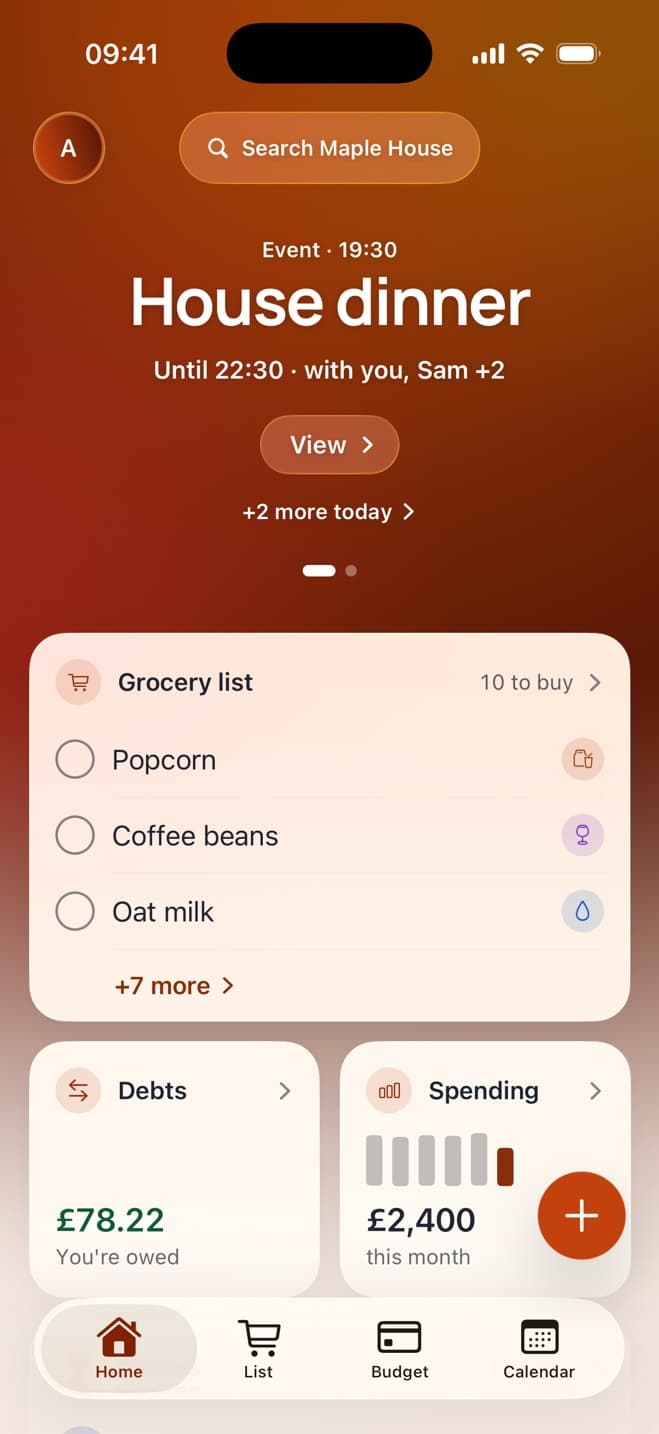
House Plan keeps those parts running for the whole apartment: rent and utilities post as recurring bills with your agreed split, chores rotate on their own with points and a monthly leaderboard, there's one shared grocery list, and a house calendar with reminders for trash day and house meetings. Free covers 2 people; a house of three or more needs Pro, which covers up to 6 roommates for $34.99 a year for the whole apartment. Your first month of Pro is free. House Plan is on iPhone; Android is coming soon.
More for sharing an apartment: how to split bills with roommates, the roommate chore chart, and everything House Plan does for roommates.